 By
Yes, Hostinger supports Node.js on its Business/Unlimited web hosting plan, on all its Cloud plans, and on its VPS plans. The cheapest plan, Premium, can't run Node.js web apps.
The catch is the process limit. I run 5 Next.js apps and 3 WordPress sites on my own Hostinger Business plan, and in October 2026 the plan's 120-process cap took my sites down even though they get very little traffic. Below I cover which plans run Node.js, how deployment works, what happened on my account, and the best alternatives to Hostinger for Node.js.
Contents7
Does Hostinger Support Node.js?
Node.js runs on three kinds of Hostinger plans: the Unlimited web hosting plan, all Cloud hosting plans, and VPS plans. Hostinger's own Node.js limits table lists the web plan as "Business/Unlimited", and my own plan still shows the Business name in hPanel.
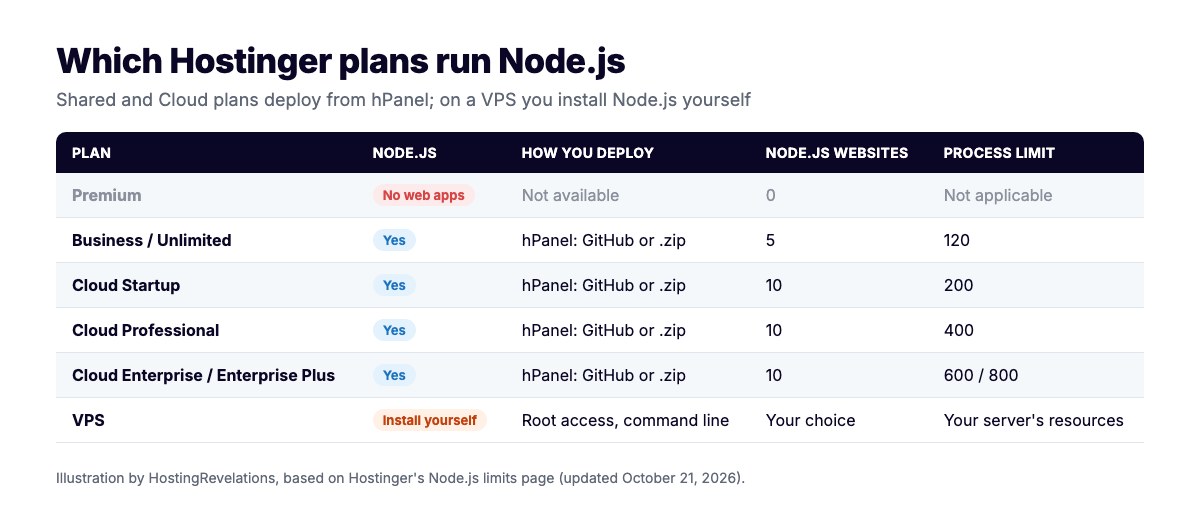
Premium can't run Node.js web apps. Its plan card lists Node.js under "Build with", but Hostinger's Node.js help pages only name Business/Unlimited and the Cloud plans.
Node.js apps need a host that can run a long-lived JavaScript process, not just serve PHP pages. On the web and Cloud plans, you deploy a Node.js app from hPanel, Hostinger's own control panel. You don't need root access or a VPS for this.
HostingRevelations itself runs as a Node.js app on Hostinger, so the experience section below comes from my own account.
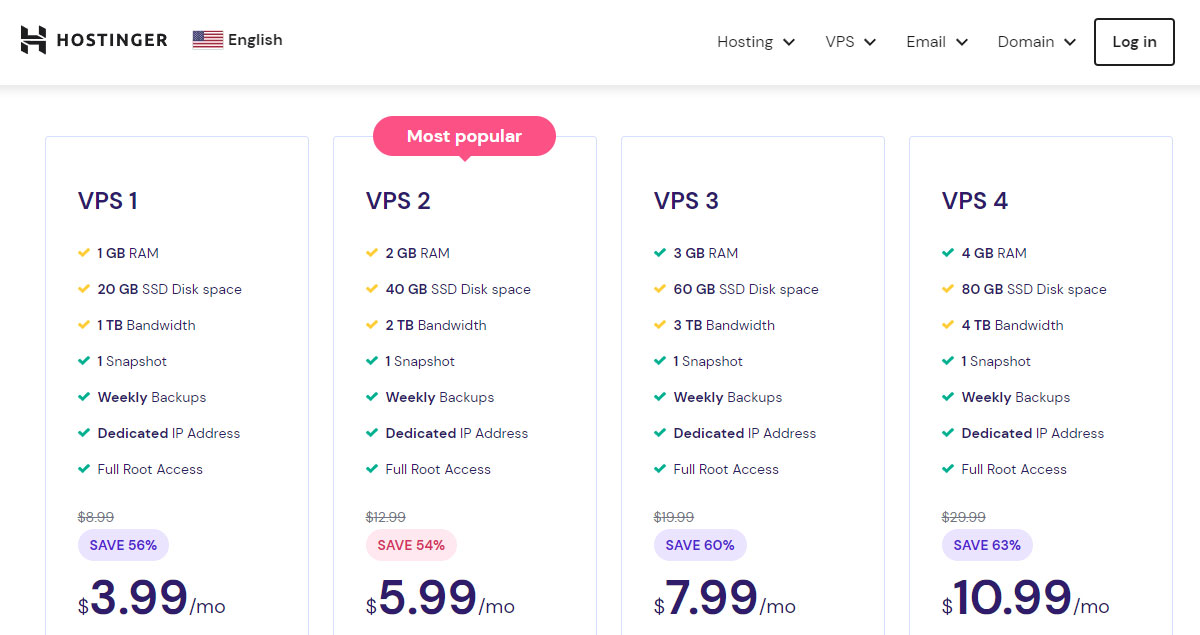
On a VPS, you get full root access and install Node.js yourself from the command line, which suits larger apps that need custom server settings.
Can you run Node.js on Hostinger’s shared hosting?
Yes, if you pick the Unlimited plan or one of the Cloud plans. The Unlimited plan costs $3.49 per month on a 48-month term (renews at $16.99), and Cloud Startup costs $7.99 per month on a 48-month term (renews at $25.99).
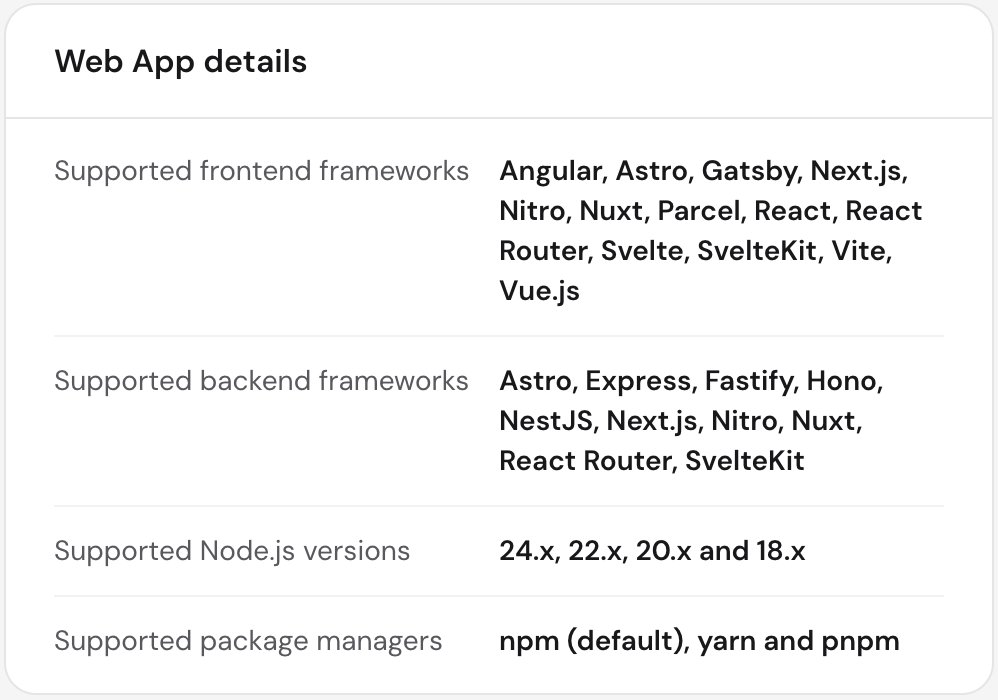
In hPanel, you create a new website, choose Web App, and then either import a GitHub repository or upload your project as a .zip file. Hostinger detects the framework and suggests the build settings, which you can change before you deploy. With GitHub, every push to the repository triggers a new build.
- Node.js versions: 18, 20, 22, and 24
- Package managers: npm (the default), yarn, and pnpm
- Frameworks: Express.js, NestJS, Fastify, Hono, Next.js, Nuxt.js, Astro, SvelteKit, and front-end tools such as React, Vue.js, Angular, and Vite
- Other apps: You can pick "Other" and set the output folder and entry file (such as
server.js) yourself
This is what the Web App details box shows in hPanel on my Business plan (October 29, 2026):
Node.js limits per plan
Hostinger publishes a separate table of Node.js limits (page updated October 21, 2026). The NPROC figure is one pool for the whole plan: WordPress sites, Node.js apps, builds and every thread they start all draw from it.
| Plan | Node.js websites | Process limit (NPROC) | Entry processes |
|---|---|---|---|
| Business/Unlimited | 5 | 120 | 60 |
| Cloud Startup | 10 | 200 | 100 |
| Cloud Professional | 10 | 400 | 200 |
| Cloud Enterprise | 10 | 600 | 300 |
| Cloud Enterprise Plus | 10 | 800 | 400 |
According to the same page, a single Next.js app takes about 10 to 11 threads, and the bare domain and its www version count as two separate processes. Hostinger also cuts off any request that runs longer than 120 seconds, blocks inbound WebSocket connections, and ends queue workers, bots and timers whenever an app is redeployed or restarted.
Shared hosting still has other limits. Your plan gets a fixed share of the server (on my Business plan, 3,072 MB of memory), and a Node.js project's node_modules folder can hold tens of thousands of files, which counts against the plan's inode limit.
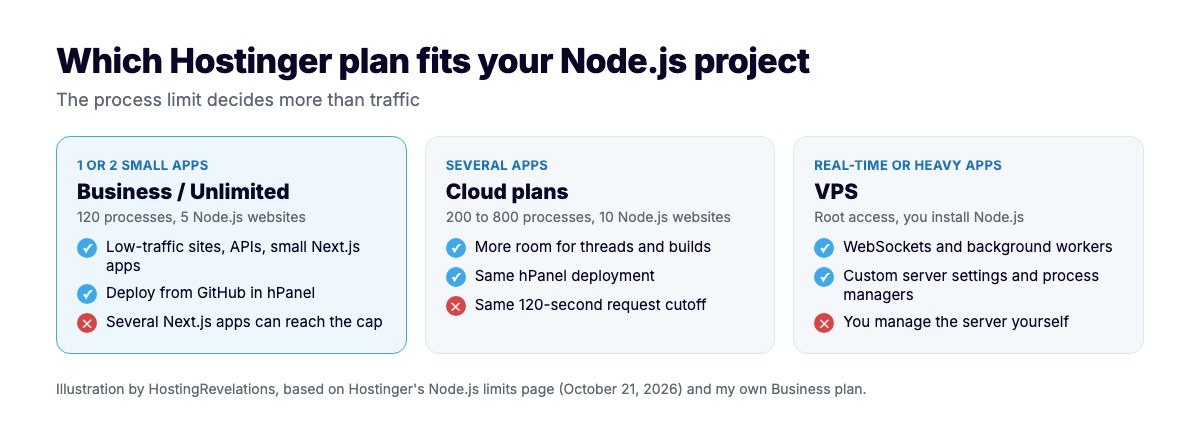
For one or two small apps this works well. For several Node.js apps, heavy traffic, or background workers, a Cloud plan or a VPS is the better choice.
My experience: 5 Next.js apps on Hostinger’s Business plan
Everything in this section happened on one plan on one server, in October 2026. It's my own account, not a controlled test, so other Hostinger servers may behave differently.
My setup
I run 5 Next.js apps and 3 WordPress sites on a Hostinger Business shared hosting plan, on a server in Hostinger's North America data center (USA, Arizona). The Next.js apps deploy from GitHub through hPanel.
Only 2 of the 8 sites get any traffic, and it's light. Five Node.js websites is also the most the Business plan allows, so I was using the full allowance.
Hitting the 120-process limit
The plan's hPanel Resources Usage page shows a limit of 120 Max Processes, and threads count toward it. In late October 2026, my usage sat at about 100 of 120 on average, with a 95% peak.
When the count reached the limit, my sites went down. SSH commands printed fork: retry: Resource temporarily unavailable, deploys failed, and Next.js builds with Turbopack crashed.
One app's stderr.log file even recorded the moment the server could not start Node.js at all, on October 28, 2026, at 01:44 UTC:
lscgid: execve():/opt/alt/alt-nodejs22/root/bin/node: Resource temporarily unavailable
That line means the app never got a process slot, not that the app itself crashed.
Where the threads went
The load came from the apps, not from visitors. On my account, an idle Next.js server held 11 threads, and a running build added about 70 more until it finished.
The bigger problem was duplicate copies. Hostinger's process manager (Phusion Passenger) left a second, idle copy of the same app running after deploys and restarts, and sometimes with no deploy at all. Each copy got no visits but kept its 11 threads.
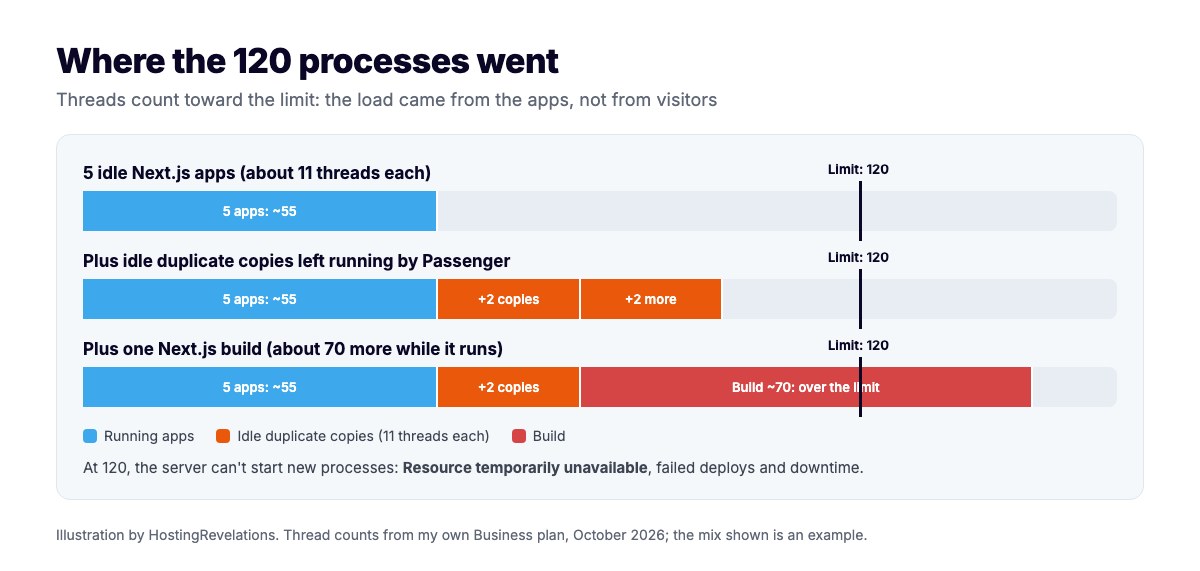
Hostinger's documentation says an app's process is stopped after a period without traffic. On my server, those idle duplicates kept running until I stopped them myself.
Stopping them cut usage from about 106 to 60 threads, and another time from 115 (at the limit) to 62. Hostinger also gives a 24-hour resource boost once a month, which I used in mid-October, but it only buys time.
What fixed it
These changes brought the plan back under control:
- Image optimizer capped at one thread: Hostinger reports dozens of CPUs to the app, and Next.js sizes its image optimizer from the CPU count. Setting
experimental.imgOptConcurrency: 1stopped it from starting dozens of threads. - Webpack builds:
next build --webpackkept working near the limit, where Turbopack builds crashed. - Matching Node.js versions: the Node.js version chosen in hPanel has to match the project's
.nvmrc. When it didn't, builds failed without a clear error. - A cron job for the duplicates: there's no
crontabcommand over SSH, so I set up a job in hPanel's Cron Jobs that runs every 15 minutes, finds a second copy of the same app, and stops the idle one. It found new copies every 15 to 60 minutes.
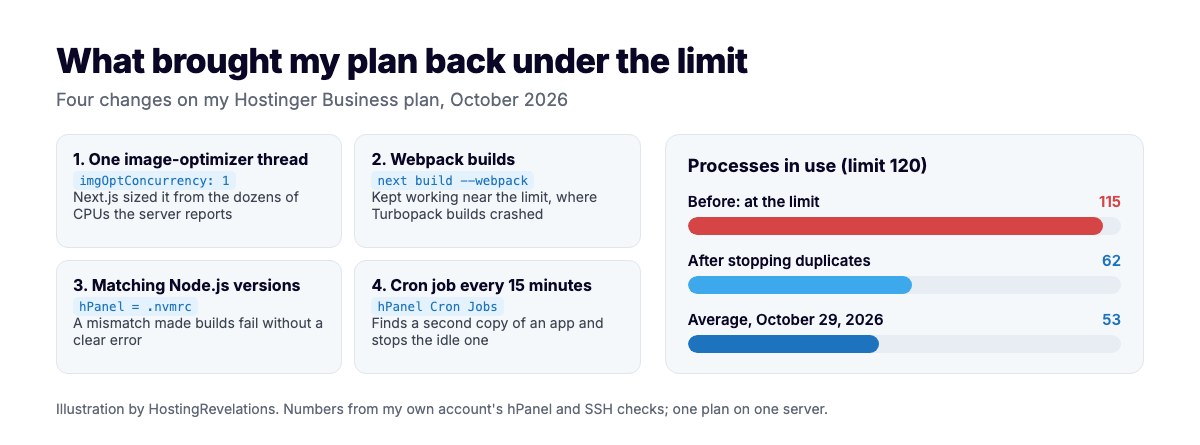
After that, usage stayed around 60 threads, and hPanel showed an average of 53 of 120 on October 29, 2026.
Even then, the Resources Usage page still showed a red "Your plan has reached its resource limits" warning next to an Upgrade plan button, most likely because the warning looks back over the last 7 days.
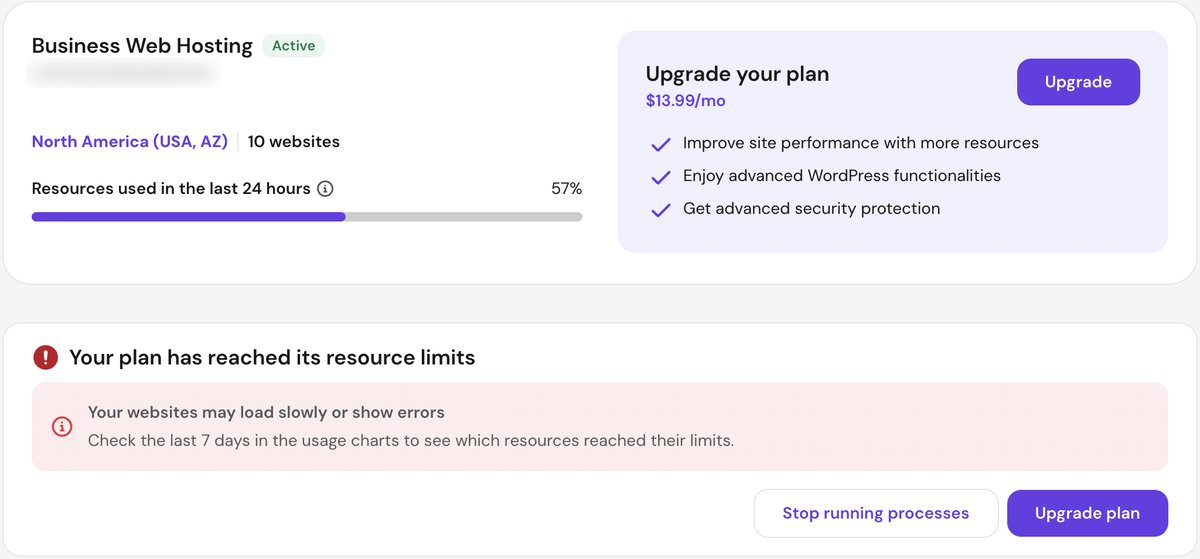
The screenshot shows 57% of resources used in the last 24 hours, taken after my fixes. Before them, that figure sat at about 98% all the time.
In my opinion, the dashboard pushes an upgrade here instead of explaining what uses the processes and how to reduce it.
What Hostinger support told me
I contacted support on October 29, 2026, through the Hostinger Agent chat in hPanel. An AI answers first, and it took me three requests to get a human review.
Even then, the specialists didn't chat with me directly. They reviewed the AI's replies, which matches how Hostinger describes its support, and a different reviewer picked up some of my follow-ups.
The first answers listed causes on my side, such as starting apps over SSH, PM2, or cluster mode, none of which I use. After I sent the stderr.log line above, the AI called it "a managed Passenger lifecycle problem requiring server-side investigation":
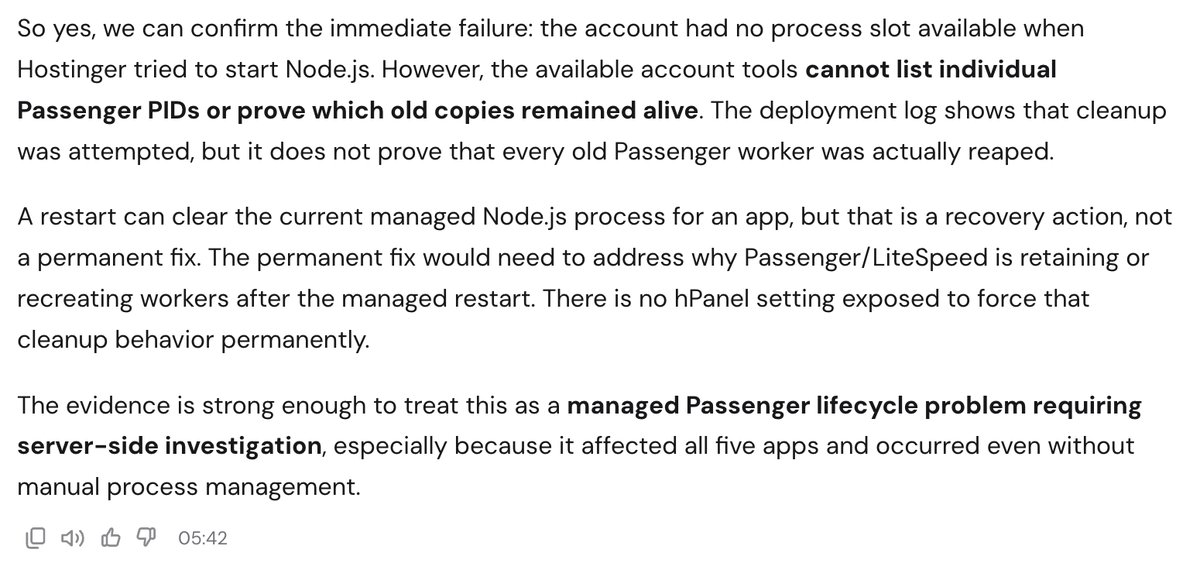
When I asked them to escalate that investigation, the reviewed reply sent me back to my own logs. It said Hostinger has "no verified Hostinger-side permanent Passenger fix to apply right now."
Email support at [email protected] was AI-first too. It suggested reducing the number of running processes or moving to Cloud Startup (200 processes), with no escalation.
The chat's last reply accepted my own diagnosis: "stopping only the stale Passenger processes is the safest temporary workaround." In my experience, support pointed at where the problem might be, but fixing it was left to me.
Who Hostinger’s Node.js hosting suits
Based on my account, one or two small Node.js apps fit comfortably on Business/Unlimited. Several Next.js apps on one plan can reach the 120-process cap even with almost no traffic.
If you plan to run several apps, choose a Cloud plan (200 or more processes) or a VPS. On Business/Unlimited, be ready to watch the process count and stop idle copies yourself. I haven't run Node.js on Hostinger's Cloud plans, so I can't say whether the duplicate copies appear there.
Best Alternative to Hostinger (shared hosting)
If you'd rather use a different shared host for Node.js, look at hosting.com, the company formerly known as A2 Hosting. Its web hosting lists Node.js among the supported languages, and the Pro plan explicitly includes Node.js support, together with 10 websites and 50 GB of NVMe storage.
hosting.com has no minimum term, a 99.9% uptime SLA, and a 30-day money-back guarantee. The Pro plan costs $3.79 per month on a 4-year term and renews at $19.99 per month.

The same shared hosting limits apply here: shared CPU and RAM, and an inode count that grows quickly with node_modules. It is challenging to scale a Node.js app on shared hosting compared to VPS or Cloud hosting.
Best Alternative to Hostinger (VPS)
When looking for an alternative to Hostinger VPS for your node app, Vultr may be your best bet.
Vultr offers a 1-click Node.js app in its marketplace, so you can skip installing Node.js by hand. Its Cloud Compute plans are affordable, and new accounts can get free credit to try the service. The amount depends on Vultr’s current promotion.

Conclusion
Hostinger supports Node.js on its Business/Unlimited and Cloud plans, where you deploy from hPanel with GitHub or a .zip upload, and on its VPS plans, where you install it yourself. The cheapest Premium plan doesn’t support it.
On shared hosting, the limit to watch is the process count, not traffic. On my Business plan, 5 low-traffic Next.js apps and 3 WordPress sites were enough to hit 120 processes and cause downtime until I capped threads and stopped Hostinger's idle duplicate copies myself.
Real-time, data-heavy apps that need more CPU and RAM, or custom server settings, are a better fit for a VPS. A VPS or dedicated server gives you complete control and a smoother experience with Node.js.
Do you have any node-related queries? Share them in the comments, and I’ll address them as soon as possible.
FAQ (Frequently Asked Questions)
Can I use Node.js on shared hosting?
Yes, you can use Node.js on shared hosting with hosts that support it, such as Hostinger (Business/Unlimited and Cloud plans). It works well for one or two small apps. For several apps, high traffic, or background jobs, a Cloud plan or a VPS is the better setup.
How many Node.js apps can I run on Hostinger?
Hostinger allows 5 Node.js websites on Business/Unlimited and 10 on each Cloud plan. In practice, the process limit matters more: on my Business plan, 5 Next.js apps were enough to reach the 120-process cap.
Is Hostinger shared hosting good?
Yes for most WordPress sites and small Node.js apps, mainly because of its cheap entry prices. For several Node.js apps on one plan, my experience shows you'll need to watch the process limit closely, and support won't fix it for you.