
 By

If you are concerned about your website’s security, two proven ways can help protect your WordPress website.
- Choosing a secure hosting service that follows industry best practices in security.
- Reinforcing your website security with a powerful third-party security service.
For WordPress security, SiteGround Security and Wordfence are the two most popular options. Both these plugins offer a strong set of security features that keep your website safe.
SiteGround Security Vs Wordfence? What should you opt for?
If you aren’t sure which of these two options is the best fit for your website, this article will help you compare them both based on the value they offer. Sounds good? Let’s dive in.
Contents6
SiteGround Security Vs Wordfence – An Overview
In this section, let’s understand what is SiteGround Security and what Wordfence is.
SiteGround Security
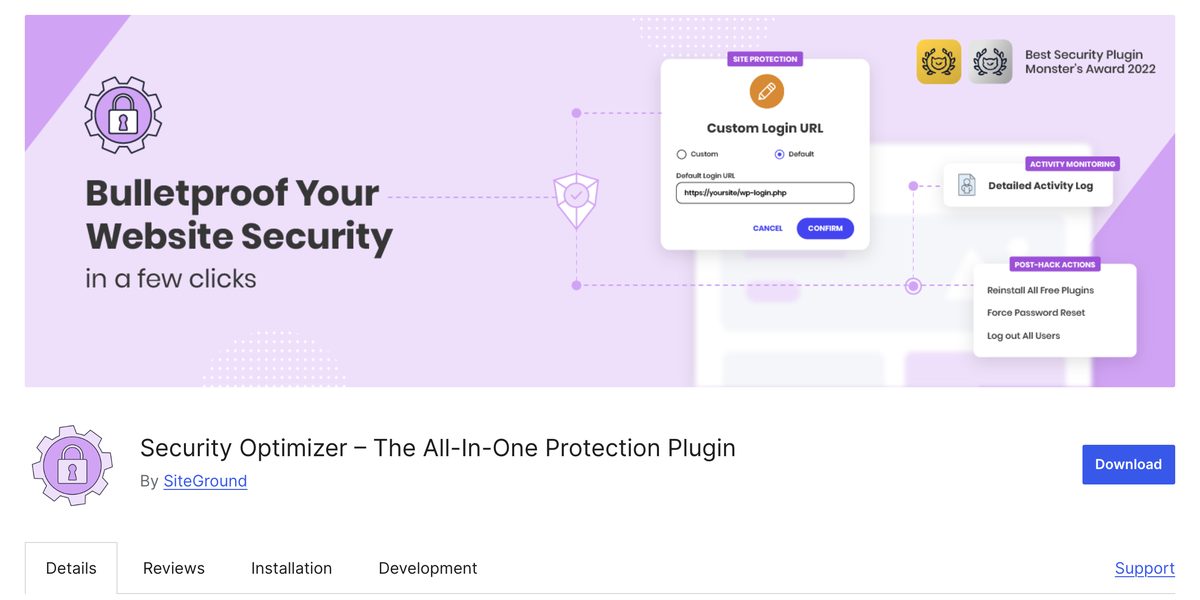
SiteGround Security is a powerful plugin that provides the toolset to strengthen your WordPress website and keep it safe from potential hackers, malware, and other malicious activities.
The plugin is free to download and comes pre-installed on WordPress sites hosted at SiteGround. In 2026 it is listed on WordPress.org as Security Optimizer (formerly SiteGround Security). It also comprises valuable tools that notify a website owner about any suspicious activity or if the website has been breached.
Key Features
- Custom login URL: The plugin allows you to change the default login URL, which can help prevent malicious attacks. You can also change the default sign-up URL if registrations are enabled on your WordPress website.
- Login access: Limit the number of users accessing the login page to a particular IP or multiple IPs. This can help prevent brute-force attacks and malicious login attempts.
- Two-factor authentication: Strengthen your login security and prevent unauthorized access by using 2-factor authentication.
- Limit login attempts: Set how many times someone can try to log in with incorrect credentials. When an IP address reaches the limit, it is blocked for one hour, and repeated failures lead to longer blocks (24 hours, then one week).
- Disable XML-RPC: Disabling XML-RPC protocol will prevent WordPress sites from communicating with third-party systems, which can minimize the number of malicious attacks.
- Advanced XSS Protection: Add an extra layer of protection against XSS attacks by enabling this feature.
- Disable RSS and ATOM Feeds: Prevent the risks of content scraping and other attacks by disabling RSS and ATOM Feeds.
- Post-hack actions: In case your website is hacked, SiteGround Security helps to reduce the damage by allowing you to reinstall all the free plugins, Log Out All Users, and Force Password Reset. The plugin options can also be managed with WP-CLI.
Wordfence

Wordfence is one of the best WordPress security plugins available today that includes a malware scanner and endpoint firewall that were exclusively designed to safeguard WordPress websites.
With a comprehensive suite of high-end features, Wordfence is one of the best security options today. It comprises of Advanced Threat Defense Feed that powers this WordPress plugin with malware signatures, the latest firewall rules, and malicious IP addresses. It runs at the endpoint, offering enhanced security as compared to cloud firewalls.
Key Features
- Advanced manual blocking: Efficiently and quickly block all malicious networks as well as robots or suspicious human activities.
- Leaked password protection: Secure your WordPress site against malicious attacks that use password information through data breaches. It can block administrator logins that use known compromised passwords.
- Live traffic: Track website visits and hack attempts that you would not get in other security packages in real-time – the origin of a visit, time of the day, and their IP addresses.
- Two-factor authentication: This is one of the most secure authentication forms available and makes brute force attacks far less likely to succeed. Wordfence supports TOTP-based 2FA and passkeys.
- Country blocking: This is a premium feature that allows you to block countries that are engaged with malicious activities.
- Repair files: If your WordPress website gets hacked, the plugin will use source code verification to help you recover from the damage. The feature allows you to check changes in core, plugin, and theme files and helps repair them.
- WordPress firewall: Web Application Firewall helps detect and block malicious traffic. Wordfence says its endpoint firewall does not break encryption, cannot be bypassed and cannot leak data. The WAF also uses malware signatures to block requests containing malicious content or code.
- WordPress Security Scanner: The advanced scanner thoroughly checks core files, plugins, and themes for bad URLs, malware, malicious redirects, SEO spam, and code injections. Regular content safety checks help detect suspicious content and dangerous URLs in your posts, comments, and files.
Pros & Cons
Here is an insight on the pros & cons of both SiteGround Security and Wordfence.
SiteGround Security Pros & Cons
Pros of SiteGround Security
- Safeguard your WordPress website against malicious attacks like brute force, common malware, and other security issues. Deleting your default readme.txt or hiding your WordPress version will make it difficult for crawlers to identify that you are using WordPress.
- Login security is further strengthened by using two-factor authentication and getting protection against unauthorized access.
- Tracking unknown visitors activity becomes simple and hassle-free with SiteGround Security’s detailed Activity log. It helps detect bad IP addresses that are trying to access your website.
- Do you think your website is hacked? The security plugin provides a set of actions in the Post-hack section that enables you to detect any suspicious activity and take measures to prevent the damage.
- Prompt customer support and a host of features that match your expectations.
Cons of SiteGround Security
- Not meant to run alongside other security plugins: SiteGround advises against duplicating security functions, which can also slow a site down.
- More security features are available with iThemes Security, Wordfence, or Sucuri. SiteGround Security isn’t a comprehensive WordPress security plugin yet.
Wordfence Pros & Cons
Pros of Wordfence
- Optimized for superior performance, with a comprehensive suite of features that ensure maximum protection against malware, bruteforce attacks, and other malicious activities. Wordfence Premium has more advanced features, while the free version also includes a host of settings, options, and features.
- Wordfence plugin is updated regularly and powered by Threat Defense Feed that brings the latest firewall rules and malware signatures to keep the website safe from many types of threats.
- The firewall plugin runs at the endpoint, which means it integrates deep into WordPress – ensuring enhanced protection like never before.
- Malware scanner that is capable of detecting many online threats like SEO spam, backdoors, bad URLs, code injections, or malicious redirects. Wordfence is one of the most comprehensive WordPress security plugins available.
- Free users get volunteer support in the WordPress.org forums, while paid plans add ticket-based support (priority tickets on Care, a 1-hour response time on Response).
Cons of Wordfence
- A host of features and options means it has a steep learning curve, which can be confusing to start with.
- For free users, new firewall rules and malware signatures arrive with a 30-day delay. In the meantime, a new threat may emerge and pose a serious threat to your website.
- Hands-on malware removal by the Wordfence team is only included in the paid Care and Response plans.
SiteGround Security vs. Wordfence: Pricing Comparison
Now that we have compared SiteGround Security and Wordfence based on their features, pros, and cons, let’s have a look at who steals the show with their pricing.
SiteGround Security
Security Optimizer (formerly SiteGround Security) is a “ free ” WordPress security plugin that can be used by any WordPress website, even if it is not hosted with SiteGround. There is no paid version of the plugin.
Wordfence
If you are considering using the Wordfence security plugin, there are two options: sign up for the “ free ” version or upgrade to “ premium.” By upgrading to the premium version, you get access to more features like the real-time IP blocklist, real-time malware signature & firewall rule updates, country blocking, unlimited scheduled scans (the free version scans every 3 days), the security Audit Log, ticket-based support, and much more.
Wordfence Premium costs $149 per year for each website, and Wordfence also sells Care ($590 per year) and Response ($1,250 per year) plans with hands-on help from its team. Care adds installation, monitoring and incident response, and Response adds 24/7/365 incident response with a 1-hour response time.
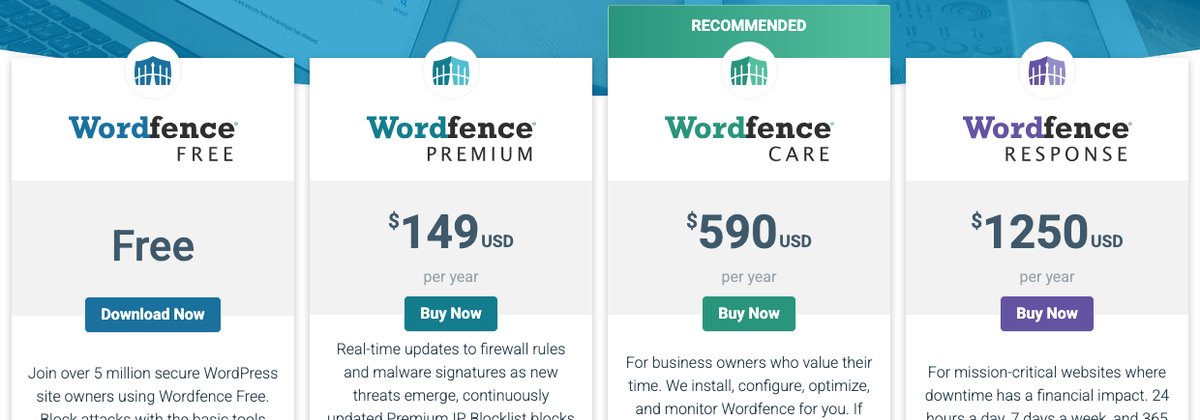
Even though you need to pay $149 per license, there is a host of advanced security features you get at that price. And it is worth it if you are serious about the safety of your WordPress website.
Do You Need Wordfence with SiteGround Hosting?
If you are already using Wordfence (free or premium), you can think about using it with SiteGround.
According to the SiteGround team, you don’t need Wordfence because the SiteGround plugin handles your security. The hosting company also advises against running other security plugins alongside SiteGround Security, because duplicate security functions can conflict and slow your site down. Therefore, it is recommended to disable all other security plugins you might be using when you sign up for SiteGround Security.
SiteGround Has Released a New Security Plugin
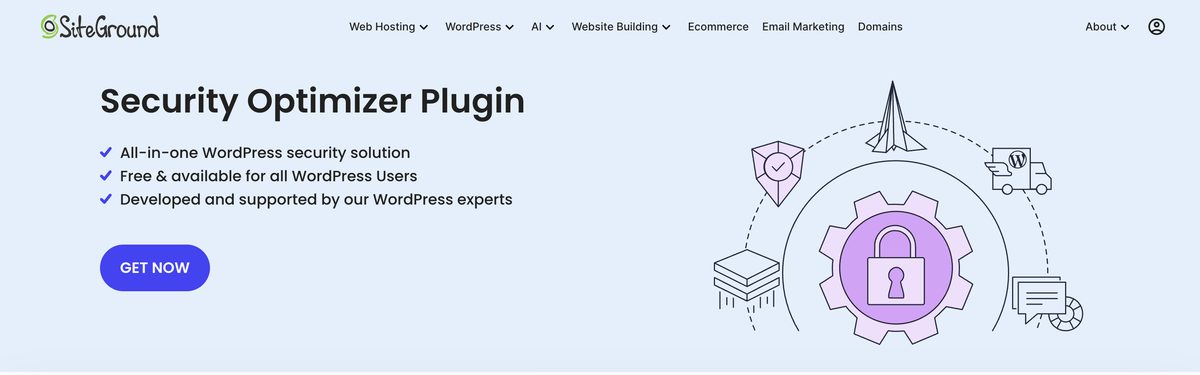
In June 2021, SiteGround introduced a new WordPress Security plugin, now called Security Optimizer. It can be downloaded for free and it can be used by any website, whether it is hosted with SiteGround or not.
However, if your WordPress application is hosted at SiteGround, the plugin is pre-installed and provides a simple way to safeguard your website from malicious attacks. This plugin is available as any other WordPress plugin through the WordPress Plugin Repository.
Features
- Protect your website against common attacks. Easily switch on the necessary rules that harden the website security and protect against malware, bruteforce, and other security problems.
- Strengthen the login security; apply several security measures that protect your login area from unauthorized access.
- Efficiently monitor your admin area through the activity log. This enables you to pay close attention to things like bad IP addresses that try to access your website and you can also keep a watch on the registered users that are executing tasks that they are not supposed to.
- Take the necessary action if you suspect that your website might have been compromised. There is a ‘post-hack’ section in this plugin that enables you to perform a set of actions that are useful if your website security is compromised.
The Final Verdict
SiteGround Security and Wordfence are both good WordPress security plugins. However, the latter has been around for a much longer time and the company solely focuses on providing high-end security to WordPress users.
So, to conclude, Wordfence is the top choice for protecting your WordPress website. However, it is important to take into consideration that this plugin consumes a lot of resources (RAM).
Therefore, if you want to use Wordfence on SiteGround, I recommend the “GrowBig” or “GoGeek” plans, because these hosting plans come with more server resources. Therefore, there will be no issues with website speed if you are using Wordfence with the higher SiteGround plans.
And if you are just starting with SiteGround’s “StartUp” plan, then the SiteGround Security plugin will be an ideal choice for you.
Read Also:
Frequently Asked Questions
Is SiteGround Hosting Secure?
SiteGround is one of the best hosting providers available and they take a dedicated approach towards ensuring high-end security for their users. Here’s how they keep their servers and your websites secure:
- Servers run current PHP 8 versions, and the Managed PHP service keeps sites on a supported version (you can also pick one in Site Tools > Devs > PHP Manager).
- An AI anti-bot system blocks brute-force attempts and malicious bots at the server level, before they reach your login page.
- Each hosting account is isolated from the other accounts on the server.
- An in-house web application firewall (WAF) runs on all servers, with rules written by SiteGround’s security team, including virtual patches for newly disclosed plugin vulnerabilities.
- Up-to-date software versions, with the latest security patches, to provide database services.
- Hassle-free and simple auto-updates available for WordPress core version, themes, and plugins, with a backup taken before each update.
- Automatic daily backups (up to 30 daily copies on shared hosting) and free SSL certificates.
- They follow strict guidelines regarding who can access your data and also keep a complete report for such access.
- Constant monitoring of modules and applications to identify and prevent vulnerabilities.
The free Security Optimizer plugin (formerly SiteGround Security) adds WordPress-level protection on top. Malware scanning (Site Scanner) is a paid add-on.
Does SiteGround have a firewall?
Yes. SiteGround includes DDoS protection on all plans, and an in-house web application firewall (WAF) runs on all its servers, with rules maintained by its security team. Its AI anti-bot system also filters brute-force login attempts at the server level, before they reach WordPress.
The Security Optimizer plugin (formerly SiteGround Security) is not a firewall, but it adds hardening rules and login protection that keep your website protected from common attacks and other malicious activities.
How do I protect my website on SiteGround?
Other than SiteGround’s approach to keep your website protected, here are certain things you can do to keep the website secure:
- Update your software regularly, including all 3rd party software installed as well as the OS.
- All web applications must be updated, including all components, addons, and modules.
- Use the SiteGround Optimizer plugin to configure the WordPress site to optimally work with an SSL certificate and ensure the traffic goes through HTTPS.
- Avoid using themes, extensions, modules, and scripts from non-official torrents and websites.
- Use the Security Optimizer plugin (formerly SiteGround Security).